
What’s worth knowing in the Squarespace world.
For designers, developers, and people building businesses around Squarespace.

35 Squarespace SEO Tips to Improve Your Search Results

For years, one of the biggest questions we get has been, is Squarespace good for SEO?
The answer is, yes, if you know what you're doing.
The problem with SEO is it can be a really daunting task. There's so much conflicting and confusing information out there.
How do you know if you're doing it right? Can you get better results with Wix or Wordpress? What about site speed? Do I need an expert or a Squarespace SEO plugin?
The most important question is, what's going to move the needle and get your site more traffic?

We've been optimizing Squarespace websites since 2015 and have learned a few things along the way.
If you're not already seeing success with SEO, these 35 actionable tips will get you on the path to improving your rankings, traffic, and sales.
But before we get into the strategic advice and more advanced tactical tips, let's make sure we have the basics covered.
Our goal is to
1. Make sure Google can find our content
2. Learn what our customers are searching for
3. Create relevant content
4. Optimize it and grow our authority
Remember SEO a long-term process, so don't expect results overnight. Let’s start with the low-hanging fruit - using your basic SEO settings and tools.
Squarespace SEO Settings
These first 10 tips I consider SEO essentials. You’ll learn the back-end Squarespace settings and what you can tweak.
1. Connect to Google Search Console and submit your sitemap.
Do this when you are launch-ready. That way you can start getting data to optimize with.
Analytics > Search Keywords > Connect

Squarespace comes with a free sitemap, which charts out every page on your site and when it was last updated. This is extremely valuable for Google to have and helps them discover your new content more quickly.
Submit it to Google via the Search Console by going to Sitemaps and adding sitemap.xml to your Squarespace domain.

Example adding sitemap from Squarespace
2. Implement SSL.
Squarespace gives you the option to use a free SSL certificate they provide. Google gives secure sites a boost over insecure sites, so turn this on.

3. Look out for mobile usability issues.
All Squarespace themes are mobile-responsive by default, but that doesn’t mean your content doesn’t have potential issues. Having Google Search Console setup will alert you of those errors.
See below for issues I’ve had to fix.

4. Customize your title tags.
Every page, blog, or product has a tab for editing your SEO title.
You’ll notice it’s also optional. The reason for this is because by default Google pulls your page title.
However, there may be instances where you want to have a title that will speak more directly to someone scrolling through search results.
Customize this using your keywords (covered below).

You can set your SEO Title in the SEO settings of your pages and posts.
5. Create a custom 404 page.
Errors happen, and people will end up on nonexistent pages on your site. Optimize their experience and give them routes to engage with your site from that broken page. Here’s how.
6. Customize your URLs.
Squarespace allows you to customize your “URL Slug”, which is the URL as it displays in the address bar of a browser and Google’s search results. Aim for something descriptive, reflective of the post title, short, and separated with hyphens. www.example.com/post-about-red-shoes is an example of a good slug.
7. Make sure images have alt text.
Image alt text is an accessibility feature, displaying when an image doesn’t load or for users who browse in visually impaired mode. It also helps Google contextualize and index your images. Here’s how to add alt text.
8. Implement Google Analytics.
Google Analytics allows you to see information about the people who visit your site, which can help you decide which topics are doing well and should be focused on, versus which are not.

Generating a Google Analytics tracking code and installing it on your site enables you to track your site’s performance and visitors.
You can easily install it with this process.
9. Use a custom domain name.
Universally, Google will give preference to a site with a real domain over a subdomain.squarespace.com domain name. Yes, it costs money (though not very much), but it’s a tangible benefit. Here’s how to set one up.
10. Use tags and/or categories.
An easy, intuitive navigational structure is important to Google and your user experience. Both tags and categories are ways of organizing content on your site. It doesn’t matter which you use – they both work fine – but pick one and implement it.
Keyword Research Tips
This last set of optimizations are very important, but they aren’t things you only do once. Rather, you’ll need to do each of these on an ongoing basis, every time you create new content for your site. Many of these tips are generic to all websites, not just Squarespace websites, as well. You’ve probably heard many of them before, but they’re worth putting into a tangible list here.
11. Perform keyword research.
Keyword research is the backbone of developing an overall content plan, guiding the kind of topics you cover. It allows you to target ads, optimize content, and reach your audience directly. It’s also very complex, so do yourself a favor and read through a few beginner guides.

Keyword research enables you to check search volume, competition, and similar terms.
12. Target reasonable keywords.
Long-tail keywords are keywords with several descriptors added to them, so they’re more specific. The audience is smaller, but so is the competition. Balancing out these two factors is critical for developing a content plan.
Learn What Google Considers Quality Content
13. Create high-quality content.
High-quality content is content that is well-written, lengthy enough to have value and is focused on providing some kind of value to your audience. It can be educational, actionable, or instructive. It’s a skill you will develop over time, or hire someone to handle for you.
14. Create long content.
The average word count for content on the web that ranks highly is around 1,300 words. The best content is often 2,000 words or more. Aim for as long as you can manage without fluff or extraneous digressions.

The average word count for web content is about 1,300 words - you want your pages to be above average to be competitive.
15. Establish good formatting.
A good blog post should have a title in H1, numerous subheadings in H2, and a good layout. Use short paragraphs, formatting like bold and italics to make content stand out, and frequent links for further reading, both internal and external.
16. Optimize your blog images.
Images are the largest part of a website, and they often slow down a site’s loading speed. Fast speeds are a powerful ranking factor, so take the time to compress and optimize images before uploading them to your site.
17. Set up internal links.
Google likes it when a page references other pages on your site and tends to reward sites with interconnected content. You can do this manually, but you can also consider installing a related posts plugin to handle some of it automatically.

Showing related posts and products is great for both sales and SEO. We created a plugin for this very purpose.
18. Link to external websites.
Google doesn’t like sites that are “selfish” and don’t link to other sites. Link to other sites whenever it’s relevant (just look at the links in this post as an example.)
19. Publish content on a regular schedule.
It doesn’t necessarily matter whether you’re publishing once every two weeks or three times a day; publishing on a regular schedule is more important. Produce high-quality content on a regular and consistent schedule, as frequently as you can keep up.
Improve How Your Website Appears In Search Results
Any time you search for something in Google and you see additional information in a result, like star ratings, pricing information, or other useful information, that data is only there because the website in question facilitated Google in finding it. Google doesn’t like scraping this on their own, because bots can be easily confused. If you implement rich snippets and Schema.org markup, however, you can make it much more likely to display, and thus help draw people to your site and into your orbit.
20. Implement Schema.org markup.
Schema markup is very complex, so we recommend using a tool to determine what data your site uses and how to implement it.

After generating Schema markup for your page, you can then paste it into the “Advanced” section of your page settings for it to appear.
This becomes especially advantageous when you’re the first in your SERPs to use it.
21. Add NAP to your About page, if applicable.
Your Name, Address, and Phone Number are important pieces of rich data Google can use, if you’re a brick-and-mortar business. Make sure to add that information to your site, and tag it for visibility.
22. Optimize your meta description.
Much like your meta title, your meta description displays in Google search. So why isn’t it on the “top tips” list? Google often ignores it. Even so, it’s better to create an optimized description than to not have one at all. Here’s how to do it in Squarespace.
23. Set up a Favicon.
A favicon is a small logo that appears next to your title on a browser tab. Google occasionally uses it, but it’s not part of SEO in general. It is, however, attractive to users and part of good branding, so it’s good to add.
24. Use a custom thumbnail for video embeds.
If you’re embedding a video from a third-party source (often YouTube) you will want to use the custom thumbnail option.
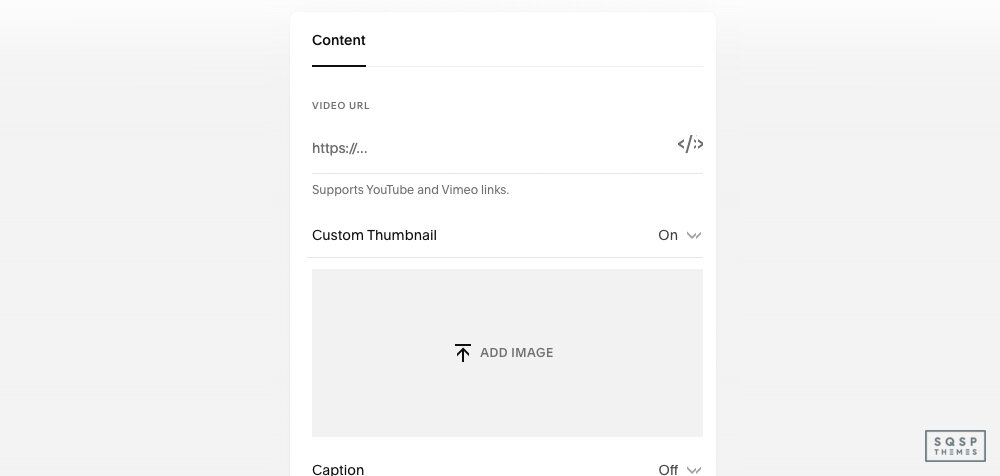
Using custom video thumbnails can reduce your page load and potentially increase your rankings.
This way the user doesn’t have to load large chunks of a video just to display the embed; they can load a much smaller preview image.
25. Add a table of contents.
A simple table of contents at the start of your posts, linking to each subheading, greatly facilitates the user experience and can be a useful part of rich data.
Increase Engagement
Google doesn’t directly measure things like bounce rates, dwell time, or comments. Or, rather, they do, but they don’t work that data directly into your calculation for ranking. Instead, these factors all contribute to a general user satisfaction level. Getting more comments, keeping users around, and successfully answering questions can all help with your SEO over time, as well as organic satisfaction and growth in your brand.
26. Embed media.
Dwell time can be increased by embedding media such as podcast audio or YouTube videos into your posts, to keep people on your site longer.

Media adds immense value to your pages and can have a powerful impact on your SEO. Use it liberally.
27. Encourage blog comments.
When you get people commenting on your site, it adds valuable content to your page, gives you potential inspiration for future posts, and gives you an avenue to engage with users and get them to come back. Encourage comments whenever you can.
28. Engage with commenters.
Whenever a user leaves a comment, as long as it’s not spam, engage with it. Thank them for their comment, answer their question, and generally make them feel appreciated for leaving the comment in the first place.
29. Optimize for social media sharing.
Pick your favorite 2-3 social networks (probably Facebook and Twitter, plus another you like) and examine how your content displays on that site. You may need to change your standard thumbnail or other data, as per this post. Make sure your links look good when shared.
30. Build backlinks.
Actively focusing on building backlinks will bring in more users. Backlinks are also a direct (and important) SEO factor. Make sure to focus on links from relevant content on relevant sites for the most value.
Bonus Tips
The last few tips on this list are entirely optional. They can help, in some cases, but they might not be relevant in others, or they may have drawbacks that you don’t want to deal with. Be sure to read about each of them in greater detail before deciding if you want to implement them or not.
31. Consider AMP support.
AMP is Accelerated Mobile Pages and is a mobile-only option to display a pared-down version of your content to users much faster than waiting for normal load times. Useful for primarily text sites, but less useful when you’re media-heavy. Squarespace supports it but I’m not sure how relevant it is today in 2024.

Squarespace supports Google accelerated pages. These may give you a boost in the search results.
32. Verify with Bing.
Bing is a competing search engine, and while Google will be responsible for 95% of your traffic, Bing and other search engines can contribute some. Verifying your site with Bing Webmaster Tools can help you keep track of how you’re performing there as well as on Google.
33. Minimize additional scripts.
Every script you add to Squarespace adds functionality but slows down your page loading times. You can think of it as the cost of using scripts. Page load times are an important SEO factor, but so are added features and functions. You’ll have to decide if a new feature is worth the cost.
34. Use a web-safe font or Google font.
Custom fonts tend to need to load the entire character set for the font, even if you don’t use more than a fraction of it on your site. Using a web-safe or Google font can help with site speed.
35. Use a pop-up script.
Pop-ups are lightboxes with, typically, a call to action. They may be triggered by exit intent scripts, timers, scroll levels, or just activity on the page. However you implement it, make sure to monitor user response; some people hate them, others don’t mind them.
When all of the above is done (minus a few of the optional tips), your site should be well on its way towards becoming an SEO powerhouse. From there, all you need to do is keep it up. Establish a routine, creating and publishing high-quality, relevant content, and you’ll see continual growth for as long as you put in the effort.

Our Favorite Squarespace Templates for Therapists
Squarespace is an excellent platform for therapists because it allows you to set up a beautiful online presence, quickly and easily. The page builder is easy to customize and you can embed scheduling so it’s easy for your clients to book your time.
These Squarespace templates are designed exclusively for therapists and psychologists by designers who care passionately about leveling up their practice online.
I’ve included templates from Squarespace’s template directory and templates from Squarespace template shops that specialize in templates for therapists.

Clove is best described as soothing and natural with its green, blue, and rust color palette. It’s tailored for a mental healthcare practice with a modern approach.
This template has all the essential pages for a clinical mental health practice – profiles, services, a team page, a patient portal, and an insurance form.
This template is ideal if you have great professional images.
2. Meriden

If you’re looking for a template with a life coaching spin. Meriden has the pages for a coaching business model that includes courses and a podcast. You can even provide memberships directly through the site.
Squarespace scheduling is also built-in so you can that for scheduling free and paid consultations.
Remember, visually these are starting points. You’d customize the branding to suit your practice.
3. Almar

If you’re an influencer who’s been published in different publications, Almar is a great option. It works great as a general professional services site too.
The layout is simple with bold imagery with space for client testimonials.
The best paid Squarespace template for therapists
4. Hold Space Creative
Founded by Monica Kovach, a former therapist and coach, and professionally trained artist and designer, Hold Space Creative exists to help you present yourself in an authentic, modern way so that your services become desirable rather than stigmatized. Sounds good huh? I got the next part from their about page.
“Hold Space Creative was born out of a desire to change the antiquated, outdated beliefs and prescriptive system for private practice marketing, empowering therapists and therapy-seekers to connect without unnecessary barriers. At my core, I value integrity, authenticity, justice, equity, and creativity.”
Here’s an example of one of the designs you can find in her shop.
Sage | Squarespace 7.1 Website

Sage is a Squarespace 7.1 website, made for therapists in private practice, coaches, or other service-based businesses. This website features a soft, earthy color palette and a minimalist design to help your website visitors feel calmed and inspired.
Price: 399.00
5. Humming Soul Creative
Humming Soul Creative specializes in creating custom Squarespace websites and branding specifically tailored for therapists, coaches, and other mental health professionals.
Naya Template

A sophisticated and minimalist template with neutral, earthy colors. Ideal for therapists targeting high-achieving women, it emphasizes personal transformation with a serene and modern aesthetic, focusing on the therapist's mission and client impact.
6. Go Bloom Creative
Go Bloom Creative is a specialized web design studio focused on creating websites and digital branding specifically for private practice therapists and other mental health professionals.
Marigold Template

A warm and inviting design with soft yellow and blue tones, perfect for therapists or coaches. It features clear sections for introducing services, credentials, and FAQs, with a focus on creating a comforting and approachable online presence.
7. High Five Design Co
Founded by Emily, a designed and licensed therapist in private practice, High Five Design features templates and design resources for a variety of styles and aesthetics.
Presence Template
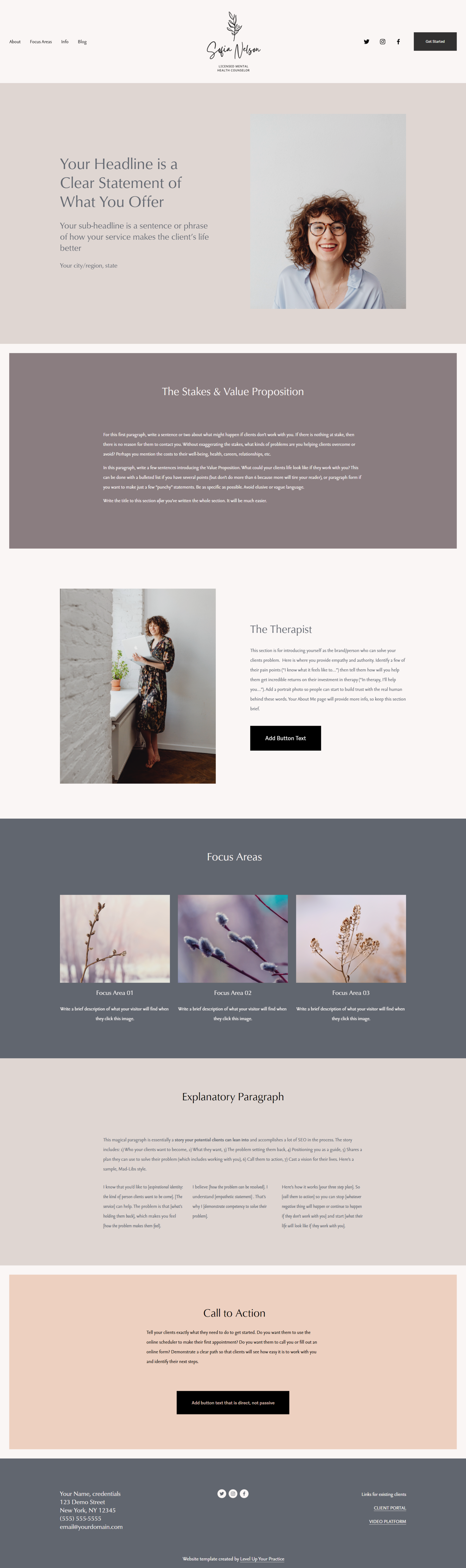
“Presence is perfect for you if…
You want a design with soft colors and a spacious feel
You don’t like clutter and you sure as heck don’t want it on your website!
This website template is built on Squarespace 7.1. It is strategically designed to boost conversions and help you attract your best-fit clients. This design is mobile-responsive and will look amazing on every device and screen size. No installation or buildout is required! You can customize fonts, colors, text, images, page layout, and overall site structure.”
Price $299
8. Walker Strategy Co
Founded by Anna to help therapists simplify their marketing and bring in clients on autopilot. Her mission is to empower therapists with the tools to grow their practices, bringing more joy to business ownership and more freedom to their personal lives, without constantly worrying about how to stand out from their peers or explain what they do.
Scout Squarespace Templates

Scout is best described as inviting, crisp and clean. This template features “large image headers, modern outline accents, and an abundance of white space, SCOUT is a highly customizable, strategic design that’s built to connect with and ultimately convert potential clients into paying ones.”
9. Therapist Site Toolbox
The Therapist site toolbox offers Squarespace templates, social media templates, and copywriting templates for therapists.
Maslow Squarespace 7.1 Template

The Maslow Template is a modern, dynamic template with overlapping sections and unique, hand-drawn graphics. This template includes 9 professionally designed web pages.
Price: $397
Need something custom?
Go live in 5 days with June Mango.
June Mango® Design is a creative studio that works with helpers, healers and holistic brands. They help you bring your brand to life so you can spend your energy supporting others. Their sweet spot lies in their branding and web design process, but they also offer other services to meet you where you are.
What’s your favorite Squarespace template for therapists?
Have any great examples to share?
Submit them to our built with Squarespace showcase.

5 Practical Tips to Keep Your Online Business Going in any Economy
What can you be doing to keep your business going today? We have a few practical tips here for business owners:
How are things going for you and your business?
This unusual period is a worrying time for many. Some people are prospering, some are doing okay, and some are finding it a struggle. Wherever you are, now is the time for practical actions to keep your business going.
Here are some of our thoughts on what you might do:
Free download: A template for your SWOT analysis
1. Keep being visible
The coronavirus pandemic is definitely an unusual challenge to deal with, both personally and professionally. However, like any other crisis period, it is temporary. Many businesses might choose to pull back on communications or marketing to their audiences, but there are some good arguments to be made for staying visible.
Firstly, there’s the fact that a pandemic is temporary. A key goal for most businesses is to come out the other side strongly and keeping up your communication and/or marketing efforts with your audience is one way to do that.
Why? Because it helps to ensure that you’re not forgotten. Most businesses work hard to build up an audience and it doesn’t take long after dropping out of site to drop out of the minds of that audience.
There are several examples we can draw from over just the last century of crisis periods. The Great Depression is one example, with the story of the rival cereal companies, Post and Kelloggs. A New Yorker article describes how Post did the “predictable thing” by reigning in expenses, including marketing budget. Kelloggs on the other hand, doubled its ad budget and released a new product - Rice Krispies. By 1933, Kelloggs had grown their profits by over 30%, even while the economy tanked, and became the predominant cereal company. Post remained behind...
Secondly, if you keep up your visibility in ways that are helpful or reassuring to your target audience, it’s a great way to keep up goodwill. In the better times to come, you want people to come back to you, remembering how your business conducted itself during the hard times.
Concerned about marketing budget? Work with what you’ve got. Continue to do things like send emails to your list and post regularly on social media. If you have the time and ability, post to your blog as well.
Is what you offer relevant in some way to the coronavirus situation? For example, if you offer some kind of product or service that makes social distancing possible? Or perhaps you simply let people know that your business can and does operate remotely.

2. Find what your customers need
Here’s a question for you: how can you help the clients you have with the needs that they have now? What about any new potential clients? Evaluate what you’re offering - does it still work for your clients or is there something else that they need more? Is now a time to adjust course slightly, or even pivot to remain relevant?
While you’re pondering these questions, consider whether anything might change during future phases of the pandemic situation. Is there something that might be needed then that you should plan for now?
In the world of Squarespace websites, we can think of a few examples of the sorts of things that customers might need now:
A viable way to do business online, especially if they largely relied upon brick-and-mortar before.
A way to boost the capacity of their website, especially if they’re now getting much more online traffic.
New functionality, for example shopping carts or setup of an online store.
A new website design. Perhaps they’re quiet right now and see it as an ideal time to take care of tasks such as website maintenance or redesign.
A branding initiative. Perhaps they need to brand themselves as a business or service that operates digitally.
Now might be a great time to conduct some market research to find out what people need. Survey your current clients and perhaps ask on social media or in networking groups. There is still plenty of need out there that Squarespace agencies or freelancers can serve, it’s a matter of discovering how you can help the most.
3. Generate leads
A great way for your business to stick around in the future is to keep working with the future in-mind. We know, this can be difficult if you’re facing a crisis: many businesses are very focused on the here and now, trying to stay above water.
However, lead generation is one thing you can do to help ensure your future. If you can put some of your time into generating more leads now, you should hopefully have a pipeline of potential clients once the crisis situation calms.
What can you do?
Keep networking and talking to people. You might meet someone, or someone who knows someone, who could use your help.
Use and promote lead generation techniques on your website. For example, maybe you have a “lead magnet” - a piece of useful content that you give away in exchange for an email address. Now might be a good time to assess and devise a new lead magnet that helps people with an urgent problem they have right now.
Build your email list. Give people a good reason to sign up for your newsletter by being helpful and relatable.
Offer and promote a service that you know people will need as soon as they’re able to get going.
4. Take the time to strategize
When was the last time you evaluated your business? Now might be a great time to conduct a SWOT (Strengths, Weaknesses, Opportunities, Threats) analysis and strategize for different possible scenarios.
People often worry the most about things that they perceive they have no control over. Businesses also tend to be weakest when they’re in a position of being reactive, dictated to by the situation they find themselves in.
Planning and strategizing help to minimize that “reactive” scenario by having plans prepared for different situations. A kind of “if this, then that” for your business. Strategizing also allows you to focus on the things you can control in a situation that may otherwise seem stressful and out of control. It definitely helps you to make good decisions if you can approach the situation from a calmer viewpoint!

5. Create new assets for your business
If you find yourself with extra time on your hands, consider how you might create something that helps your business in the future. Maybe it’s something that promotes your services better (how many people badly need to revamp their own website?), or maybe it’s a new product or service you can sell. As an alternative, maybe there’s a new skill you can learn that will help you to grow your business.
We’re not going to say “you should be productive” along the lines of Shakespeare churning out plays during quarantine, or Sir Isaac Newton discovering gravity - people already tend to put enough pressure on themselves. Sometimes it can seem overwhelming, this idea that if you’ve got a quieter period, you should come out of it with something huge.
What can you do to avoid being overwhelmed, yet come out with something useful for your business? Start out with the small things. This can help to get you on a roll with achieving and to develop plans to work on anything bigger.
Download our SWOT analysis template here
Final thoughts
This is a challenging period for everyone on some level. It’s not easy dealing with a widespread crisis situation of which you have no previous experience.
As a business owner, it can help if you look for the practical steps you can take. This allows you to have some level of control at a time when things may seem chaotic. We hope you can find something in these tips that you can apply.
Lastly, stay well! Look after yourself and do what you need to keep physical and mental health. We appreciate you being here and hope to have you back.