
What’s worth knowing in the Squarespace world.
For designers, developers, and people building businesses around Squarespace.

Turn Your Squarespace Photography Website Into a Client Magnet
So many talented photographers struggle with the same thing: a beautiful portfolio of work, but a website that doesn’t do them justice. Maybe it’s confusing to navigate. Maybe the messaging doesn’t clearly reflect their brand or speak to the right clients. Or maybe there are simply too many images without real curation, leaving visitors overwhelmed instead of inspired.
Here’s the truth: your website isn’t just a gallery. It’s your hardest-working team member - the first handshake with a potential client. In just a few seconds, people are deciding if they like your style, if you feel like an expert they can trust, and whether you’re the right fit. If your site doesn’t answer those questions quickly, they’ll move on.
The good news is that a handful of intentional updates can make your Squarespace photography website feel clearer, more professional, and ready to book your dream clients.
Let’s break it down, starting with the part of your site most people see first - your homepage.
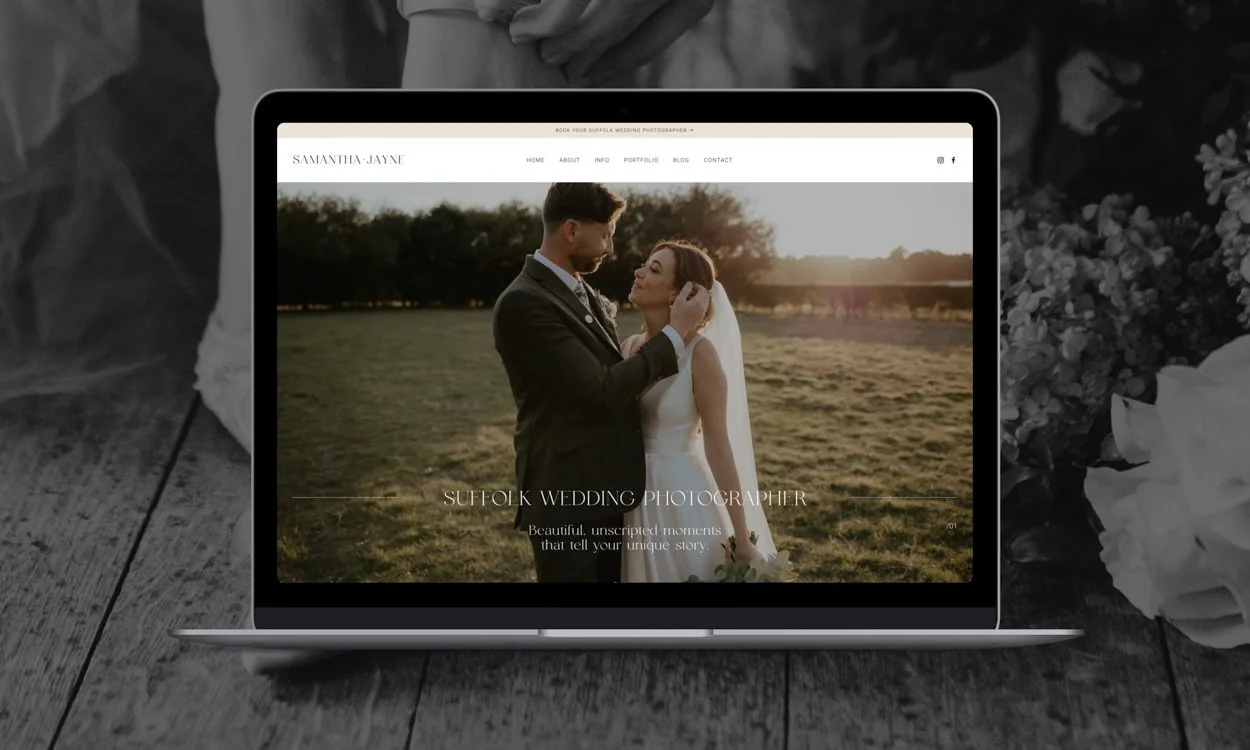
1. Homepage Clarity
Your homepage is prime real estate. Think of it like your storefront: people glance in, scan, and decide if they want to stay.
It’s also where you set the tone for both visitors and Google. Start with a keyword-rich headline that combines your service with your location - for example, ‘Editorial Wedding Photography New York’ or ‘Family Photographer in Maine.’
Alongside this, your opening messaging should make it clear what sets you apart, whether that’s your style, approach, or personality. Once that foundation is in place, layer in trust-builders like testimonials, venue knowledge, or publication features, and then reinforce that authority and consistency across the rest of your site.
In short: say what you do, where you do it, and why it matters - clearly, confidently, and in language your dream clients will instantly connect with.
On your homepage, make sure to include:
● An intro that explains how you work and what you offer
● Your best images curated as a cohesive collection (don’t just use brides and grooms - mix in details and portraits for interest)
● Links to blog posts or real weddings or shoots - three is ideal, and choose venues or locations you’d love to book again
● FAQs and a “venues I love” section. Squarespace’s accordion block is perfect for natural language but keyword-rich FAQs to boost SEO
● An “as featured in” section with publication logos or awards
● Testimonials. Real words from real couples carry weight
● A strong call-to-action: “Check if I’m free for your date.”
For example, on Samantha Jane Photography’s website, her homepage combines a strong hero image with her primary keyword above the fold, plus links to blogs, testimonials, FAQs, and venue knowledge - giving both visitors and Google confidence she’s an expert.
2. Storytelling & Branding
Your photos show your craft, but your brand tells your story and it needs to resonate with the clients you most want to attract.
If your ideal couples are adventurous and fun, your site should feel bold and playful, with vibrant colours, modern fonts, and relaxed, chatty copy. If they’re editorial and refined, your site should feel calm and elegant, with muted palettes, serif fonts, and confident, minimal copy.
Every element plays a role: colours create the atmosphere, fonts set the tone, your copy speaks directly to your client in a way that makes them feel understood, and your imagery shows the kind of stories you want to be known for.
On Katie Rogers’ site, for example, we focused on elegant branding and carefully curated imagery - from muted tones to classy serif fonts to refined copy - all reflecting her editorial film style. Visitors instantly know whether her approach resonates with them.
3. Curating Imagery
Too many images can create overwhelm. A curated gallery shows confidence and builds trust.
I usually suggest one highlights gallery with 30-40 of your strongest images. Make sure they share a consistent edit and flow well together on the page and include a good mix
of wide shots, close-ups, and details so the gallery feels confident and varied without overwhelming visitors.
Alongside your highlights, use blog posts to showcase real weddings or shoots. A gallery shows your range, but a blog demonstrates consistency across a full wedding or shoot. It reassures potential clients that you can deliver from start to finish.
4. SEO That Works While You Sleep
SEO is what ensures people actually find your site. It doesn’t have to be complicated. Focus on:
● Homepage H1 title: combine your service + location. “California Wedding Photographer | Natural, Storytelling Photography.”
● Meta descriptions: write them like ads, not afterthoughts.
● Alt text: describe the image clearly, and include the keyword where it makes sense (not on every image).
● Footer keywords: add a line like ‘Based in California and capturing weddings throughout Los Angeles, San Diego, Palm Springs, and beyond.’ It reinforces your location site-wide.
● Natural language in paragraphs: write in a way that sounds natural to humans but also includes your primary keyword and related semantic keywords. This helps Google understand the context of your page.
● Blog with intent: every real wedding is a keyword opportunity. Title posts with the venue + your service.
● Internal linking: make sure you add 3-5 links pointing back to your key “money pages” - usually your home and service pages. Link to them from your blog posts, gallery pages, even your 404 page if you want to guide people back. This signals to Google that those pages are the most important, and helps clients find them too.
● Keywords: focus on one main keyword per page. Don’t try to rank the same phrase across your whole site. Use tools like SEO Space to find the right keywords and avoid using the same keywords on multiple pages.
5. Building Trust
Photos make people stop and look. Trust makes them book. You can build trust in simple but powerful ways:
● Scatter testimonials across your site, not just on one page
● Show your face. A friendly, professional portrait makes you relatable ● Be transparent with pricing. Even “packages from £X” sets expectations Use human calls-to-action, like “Check if I’m free for your date,” instead of “Submit.”
● Share logos from features, awards, or associations
● Demonstrate local expertise with venue blogs and planning tips Trust is the difference between someone admiring your work and actually reaching out.
6. Capture the “Not Yet” Clients
Most people visiting your site aren’t ready to inquire right away - they might be browsing, comparing photographers, or still early in their planning. That doesn’t mean they’re lost.
Offer them something valuable to download in exchange for their email address - a simple PDF like ‘10 Tips for Choosing Your Wedding Photographer’ or ‘How to Get the Best Photos on Your Wedding Day.’ It should feel useful, easy to digest, and relevant to the exact kind of clients you want to attract.
Once they download it, you can follow up with a friendly welcome sequence - share more about your approach, link them to your best galleries or blog posts, and gently guide them towards booking when the time is right.
A thoughtful lead magnet means your website doesn’t just capture inquiries in the moment, it also starts conversations with the clients who will be ready a little further down the line.
Final Thoughts
A beautiful website is the foundation, but what really makes it work is the feeling it gives your clients. When your words resonate, your images are thoughtfully chosen, and your site quietly builds trust at every turn, people don’t just admire your work - they feel ready to reach out.
That’s when your photography website becomes a true client-winning magnet!
About the Author
Clare Butler is a Squarespace designer and SEO consultant based in the UK. She creates clean, thoughtful websites for photographers, creatives, and wellness professionals.

Why Normal Pricing Advice Doesn't Work
Most pricing advice tells you to "know your worth" or "price based on value." This is useless because:
You already know you're undercharging - the problem isn't awareness
Value is subjective - you can't control how much someone values something
It's all theory - there's no practical system for actually making the change
The real issue is that you need a way to increase prices that feels safe, systematic, and removes the emotional weight of the decision.
The 3-Rep Method: How It Works
Here's the system I've used to help dozens of service providers systematically increase their prices without the fear:
Every 3 "no-brainer" clients, double your price.
That's it. But here's how to define a "no-brainer" client:
A no-brainer client is someone who:
Says yes to your current price without negotiation
Doesn't ask for discounts or payment plans
Seems relieved to find you (not just satisfied)
Thanks you multiple times throughout the project
The project feels easy relative to what you're charging
The Progression Looks Like This:
Clients 1-3: Charge your current rate (let's say $3,000)
Focus on delivering exceptional results
Document everything that works
Collect testimonials
Clients 4-6: Double to $6,000
Same service, same process
Watch for no-brainer signals
Refine based on what you learned
Clients 7-9: Double to $12,000
Add slight improvements from your learnings
Continue tracking no-brainer responses
Document what makes it worth this price
Continue the pattern...
Why This Method Eliminates Fear
1. You Have Proof It Works
By the time you raise prices, you've already proven the value with 3 successful clients. You're not guessing - you have receipts.
2. The Math Makes Sense
You're not trying to go from $3K to $20K overnight. Each jump feels reasonable because you've validated the previous level.
3. You Keep the Easy Clients
You're only counting "no-brainer" clients. This means you're pricing for people who already see the value, not trying to convince skeptics.
4. Failure Isn't Catastrophic
If someone says no at the new price level, you haven't lost anything. You go back to the previous level, get another no-brainer client, then try again.
Real Example: Casey’s Journey
Casey started at $2,300 for brand + website packages. She was getting "that's it?" responses but was afraid to raise prices.
Using the 3-rep method:
Clients 1-3: $2,300 (all said yes immediately)
Clients 4-6: $4,600 (still no-brainer yeses)
Clients 7-9: $9,200 (one negotiated, two said yes immediately)
Current: $18,400 and booked 2 months out
The key: she didn't jump to $18K overnight. Each step felt manageable because it was validated by the previous three clients.
The "No-Brainer" Client Signals
Watch for these responses that indicate you should raise prices:
What they say:
"When can we start?"
"That's totally reasonable"
"I was expecting it to cost more"
"That fits perfectly in our budget"
"Do you have availability sooner?"
What they do:
Pay the deposit within 24 hours
Don't ask for discounts or payment plans
Refer you to others before the project is done
Add services mid-project without questioning cost
Book you for additional work immediately after
What you feel:
The project feels easy relative to the price
You have extra capacity to go above and beyond
You're not stressed about covering your costs
You enjoy working with them
You'd happily do 10 more projects just like this one
Common Objections
"But what if the market won't bear higher prices?"
If you're getting no-brainer clients at your current price, the market has already told you it will bear higher prices. You're not testing the entire market - you're testing people who already value what you do.
"What if I lose momentum by raising prices?"
You're only raising prices after proving demand at the current level. The momentum comes from working with better clients who value your work more, not from volume.
"What if my work isn't worth that much?"
Your work is worth what no-brainer clients pay for it. If three clients happily paid $5K, your work is worth at least $5K. The next test is whether it's worth $10K.
"What if I get fewer clients?"
You will get fewer clients. That's the point. You want clients who value what you do enough to pay properly for it. Quality over quantity.
Advanced: The Reset Strategy
Once you reach a price where you're no longer getting no-brainer clients consistently, you have two options:
Option 1: The Plateau
Stay at this level and fill your capacity with clients who value your work at this price point. This is perfectly fine and often the right choice.
Option 2: The Reset
Create a new, lower-priced offering that strips out some elements but maintains the core value. Start the 3-rep method again with this new offering.
Example: If you plateau at $15K for full brand + website, create a $7,500 "website refresh" offering and start the cycle again.
The Long Game
This isn't just about raising prices. It's about systematically positioning yourself to work with clients who value what you do. Higher-paying clients tend to be:
Less demanding about timeline
More collaborative and trusting
Better at communicating their needs
More likely to refer similar clients
More appreciative of good work
The 3-rep method gets you there without the anxiety and guesswork that keeps most service providers stuck at the same rates for years.
Your Next Step
Look at your last 10 clients. How many were "no-brainer" clients at your current pricing? If it's fewer than 7 out of 10, focus on finding better clients at your current rates first. If it's more than 7 out of 10, you're ready to double your prices for the next inquiry that comes in.
The fear of losing clients by raising prices is normal. But the cost of staying underpriced indefinitely is much higher than the risk of losing a few clients who don't value your work properly.
Here’s to your next raise 🥂

Why “Niche Down” Hasn’t Worked For You (And What To Do Instead)
If you’ve been in business for a while, you’ve heard the advice: niche down.
Pick an industry. Write your copy. Build a package around your “ideal client.”
But if you’ve actually tried it, you probably know how it goes: nothing happens. Or worse — things start to feel smaller. Like you’re cutting yourself off from people you know you could help.
So why doesn’t “niche down” work the way it’s sold?
Why “Niche Down” Fails
Most niche-down advice asks you to invent an ideal client out of thin air:
“Sally, 35, drives a Tesla, drinks oat-milk lattes, and needs a new website.”
But when Sally never shows up, you’re left feeling discouraged. That’s because the advice forces you into imagination where you don’t have evidence. It’s like building a bridge over thin air.
The Real Goal Is Clarity That Expands
The goal isn’t to shrink yourself into a smaller corner of the market. The goal is to get clear — so you can expand.
And clarity doesn’t come from imagination. It comes from your receipts.
How to Find Your Real Focus
Look back at every client you’ve worked with and sort them into three buckets:
Highest ROI – Who got the most long-term value from your work?
Most Profitable – Which projects gave you the highest margin with the least strain?
Most Exciting – Who would you happily work with again and again?
Now look for the overlap. That “sweet spot” is your real focus. It’s not theory. It’s grounded in the clients who’ve already proven your value.
Reverse-Engineering the Serendipity
Here’s where most people stop — they identify a pattern, but don’t act on it.
The next step is to reverse-engineer the serendipity. Why did those clients show up when they did?
What were they wrestling with before they became your client?
How long had they been thinking about solving that problem?
What words did they use when they described it?
Who referred them, and how were you positioned in that referral?
The more you understand these answers, the clearer your marketing becomes.
Become a Master of the Pre-Client Problem
This is the key.
Your best clients didn’t just wake up one day and hire you. They were struggling with something before they became a client. That pre-client problem is the doorway.
If you can become a master at solving (or even just clarifying) that problem, you’ll create a natural flow of new clients. Why? Because helping them through it makes becoming your client the next logical step.
The Shift
Once you see the patterns, you stop feeling like every great client was a rare unicorn. You realize they’re not one-offs — they have doppelgängers. And there are dozens, hundreds, even thousands more just like them.
Your job isn’t to niche down into scarcity. It’s to niche in to clarity.
That’s how you build a pipeline of future demand instead of waiting around hoping luck repeats itself.
Next Step
This is exactly what we’re working on inside the 90-Day Double Your Squarespace Business Intensive. We help you:
Identify the patterns in your past clients.
Master the pre-client problem.
Align your offers with the demand that already exists.
The waitlist for the next cohort is open at sqspthemes.com/waitlist.
Because once you see the clarity in your own work, you’ll realize you never needed to niche down. You just needed to niche up.