At Circle Day 2026 on October 21, Squarespace introduced Forma, a new AI-powered environment for building websites and custom applications.
It's an interesting development for a company that has spent more than two decades making website creation accessible. But Forma appears to represent something broader than another way to build websites.
During the opening keynote, Squarespace President Kevin Doerr spoke about a future in which websites, applications, and AI agents increasingly overlap. He also acknowledged a familiar problem for businesses: managing multiple software subscriptions that don't necessarily work well together.
Forma could offer a different approach, allowing people to create software tailored to their needs rather than assembling several separate applications to accomplish the same thing.
For Squarespace professionals, the announcement raises questions about both the opportunities ahead and how their existing work might change.
What is Squarespace Forma?
Forma is a new AI-powered builder designed to help people create websites and applications using natural-language instructions.
Rather than beginning with a template or a traditional development environment, the idea is to describe what you want to build.
Squarespace's early examples include an application that manages inventory for an online store and sends notifications when stock runs low.
Other examples presented around the announcement include a cycling club website with a weekly class schedule and a portal where students can share and download study notes.
These examples illustrate something different from generating a website's layout, imagery, or written content.
They involve creating tools that serve specific functions within a business or organization.
That's an important distinction, particularly considering Squarespace already has an AI-powered website builder in Blueprint AI.
Forma suggests the company is exploring what happens when the same accessibility that helped make website creation easier is extended to application development.
Exactly how far those capabilities will extend remains to be seen.
Is Forma replacing Squarespace?
One thing Squarespace made clear at Circle Day is that development of its existing website platform is continuing.
The company announced several additions to Squarespace 7.1, including expanded Stack styling, new custom code capabilities with React support, improvements to customer management, and additional developer tools.
It also demonstrated the Squarespace MCP, which allows supported AI assistants to interact with Squarespace services.
These are separate developments from Forma, but together they offer a clearer picture of the company's direction.
Squarespace is continuing to improve its existing platform while investing in new ways for people to build and operate digital experiences.
Forma isn't being presented as a replacement for Squarespace 7.1.
It's an entirely new product initiative.
How the Squarespace community is reacting
Following the announcement, I asked members of our Squarespace Entrepreneurs Facebook group what they thought of Forma.
The responses reflected a mixture of curiosity, uncertainty, and excitement about what might come next.
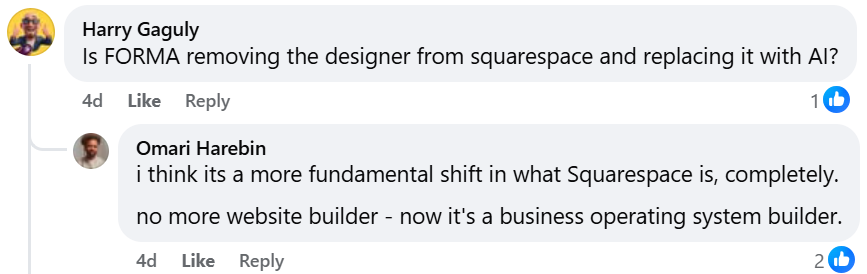
Harry Gaguly raised a question that's likely on the minds of many designers: Is Forma removing the designer from Squarespace and replacing them with AI?
It's a reasonable question. As tools become capable of performing work that previously required specialized technical skills, the role of the professional inevitably changes.
But my initial reaction was that Forma represents something more fundamental than the automation of website design.
I think we're witnessing a potential shift in what Squarespace itself is becoming.
No longer just a website builder, but something closer to a business operating system builder.
That's my interpretation, of course, rather than Squarespace's official positioning. But when I consider the broader announcements at Circle Day, it's a direction that makes sense to me.
Shannon Casey was particularly interested in the application-building possibilities and the opportunity to bring together software systems that businesses already use.
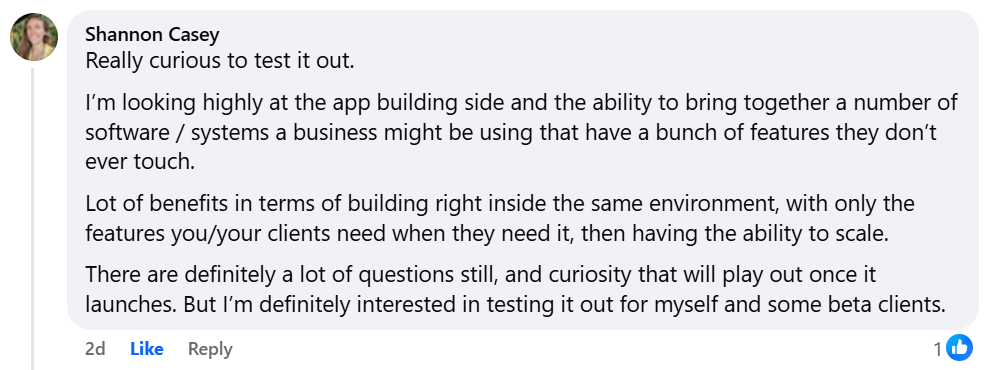
Shannon's observation gets at one of the more interesting possibilities.
Think about the number of applications a small business might use to manage its operations: scheduling, customer relationships, inventory, payments, project management, and internal workflows.
Each application may serve a useful purpose, but businesses often end up paying for functionality they barely use while spending additional time connecting everything together.
What if, instead, they could build the tools they actually need?
And what if those tools could evolve alongside the business?
There's an interesting opportunity here for professionals who understand not only how to build something, but how to identify and solve the problems their clients encounter.
Priya Anand expressed interest in exploring what comes next, particularly after observing how much of the broader Circle Day conversation focused on incorporating AI into existing design workflows.
As Priya put it:
I was particularly interested in exploring what comes next, how the industry is evolving, and how we can build on what we’re already doing.
She also noted how difficult it was to find additional information about Forma following the announcement.
That's understandable. The product is still in its earliest stages, and much of what people want to know hasn't been made public.
Bryan Jernigan offered a succinct observation about the shifting landscape:
However, new world, new problems to solve. The beat goes on!
I think there's something worth considering in that response.
New capabilities don't eliminate the need for people to understand problems and develop meaningful solutions. They change what's possible, how that work gets done, and sometimes who can participate.
What could Forma mean for Squarespace professionals?
I've been building with Squarespace since 2012, and I've watched an entire ecosystem develop around the platform.
Designers, developers, agencies, educators, and independent software businesses have all found opportunities helping people do things with Squarespace.
Some of those opportunities emerged from what the platform made possible. Others emerged from what it couldn't do.
Forma could introduce an entirely new category of work.
A project that once involved building a website and connecting several third-party applications might evolve into creating a more complete digital environment for a client.
That could mean custom dashboards, client portals, inventory systems, scheduling tools, or applications we haven't considered yet.
Of course, making software easier to create doesn't automatically mean every business should create its own software.
Doerr acknowledged this during his keynote, explaining that certain foundational services, including payments and email infrastructure, are better handled by established providers because of their complexity and security requirements.
The opportunity isn't necessarily to rebuild everything.
It's to make it easier to assemble the right capabilities around a business's particular needs.
And that requires something technology alone can't provide: an understanding of the business, its customers, and the problems worth solving.
What we still don't know about Forma
Despite the announcement, there's still relatively little publicly available information about Forma.
Squarespace has opened a waitlist at squarespace.com/forma, but pricing, general availability, and detailed technical documentation have not yet been announced.
There are also important questions about how applications will be hosted, maintained, and updated, how deeply they'll integrate with existing Squarespace websites, and what level of control designers and developers will have over the resulting applications.
Although the public website describes Forma as a beta, Squarespace leadership characterized the early access experience at Circle Day as the beginning of alpha testing.
In other words, this is still very much a product in development.
We'll have a better understanding of its capabilities and limitations as access expands and people begin building with it.
A new chapter for Squarespace?
One of the things I've always appreciated about Squarespace is the relationship between good design and good engineering.
The platform made it possible for people to create sophisticated websites without needing to understand every technical detail behind them.
That accessibility created opportunities for people like me, and for thousands of others who built businesses within the Squarespace ecosystem.
Forma appears to be exploring a similar idea, but with a much broader definition of what people can build.
Whether it succeeds will ultimately depend on how well it solves real problems.
The technology may be impressive, but businesses don't necessarily need another tool. They need better ways to accomplish what they're already trying to do.
And that, to me, is where Forma becomes interesting.
Interested in exploring Forma? Visit squarespace.com/forma to join the waitlist.
What do you think Forma means for the future of Squarespace? Join the conversation in our Squarespace Entrepreneurs community, or share your thoughts in the comments below.